According to NASA, Earth Also Has a Second Moon
Space scientists have confirmed that a new quasi-moon named 2025 PN7 is moving around Earth.

This tiny asteroid was discovered on August 2, 2025, with the Pan-STARRS telescope in Hawaii. Archive images later showed it had been visible since 2014 but remained unnoticed until now due to its small size and faint brightness.
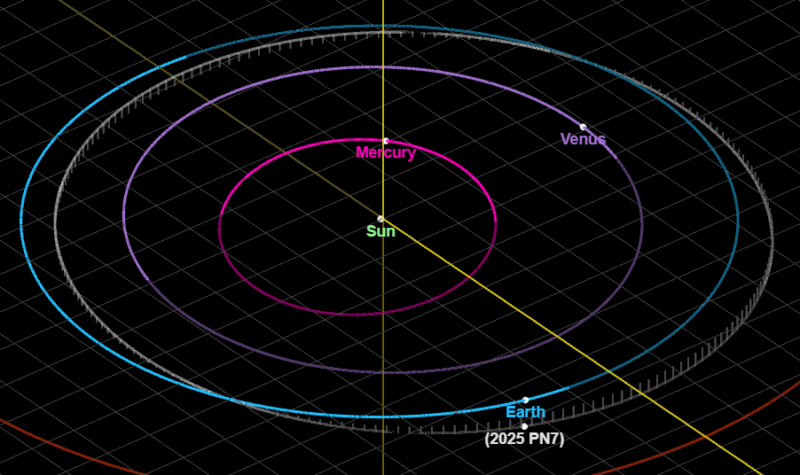
The asteroid is approximately 19 meters in diameter and moves in sync with Earth around the Sun, being in a so-called 1:1 resonance with it. It belongs to the Apollo asteroids, whose orbit is almost identical to Earth's.
Unlike the Moon, 2025 PN7 is not permanently bound by Earth's gravitational pull, but it moves at the same pace and will remain close to us for approximately the next 128 years. Sometimes it approaches Earth to within 299,000 kilometers—nearly the Moon's distance—and then drifts back millions of kilometers away. Over time, its orbit may change from 2025 PN7's trajectory to a so-called horseshoe-shaped orbit due to gravitational perturbations.
According to scientists, this asteroid offers an extraordinary opportunity to study orbital resonance and the dynamics of small bodies. Since it's stable, small, and relatively accessible, it could become a potential research target for space probes in the future, studying asteroid composition, planetary defense, or even the early Solar System's formation.
In a spiritual sense, 2025 PN7 can be seen as a new companion moving invisibly and in balance beside us. If the Moon symbolizes our inner rhythm, this silent companion tells the story of unity and destiny's synchronicity. It reminds us that even when our path seems solitary, the universe always moves alongside us, reflecting our development and calling us to notice the invisible harmony that connects science and soul.
Author

Maria is a respected astrology enthusiast. Through her widely read columns, she helps readers use the ancient wisdom of the stars to navigate modern life with awareness and intention.